
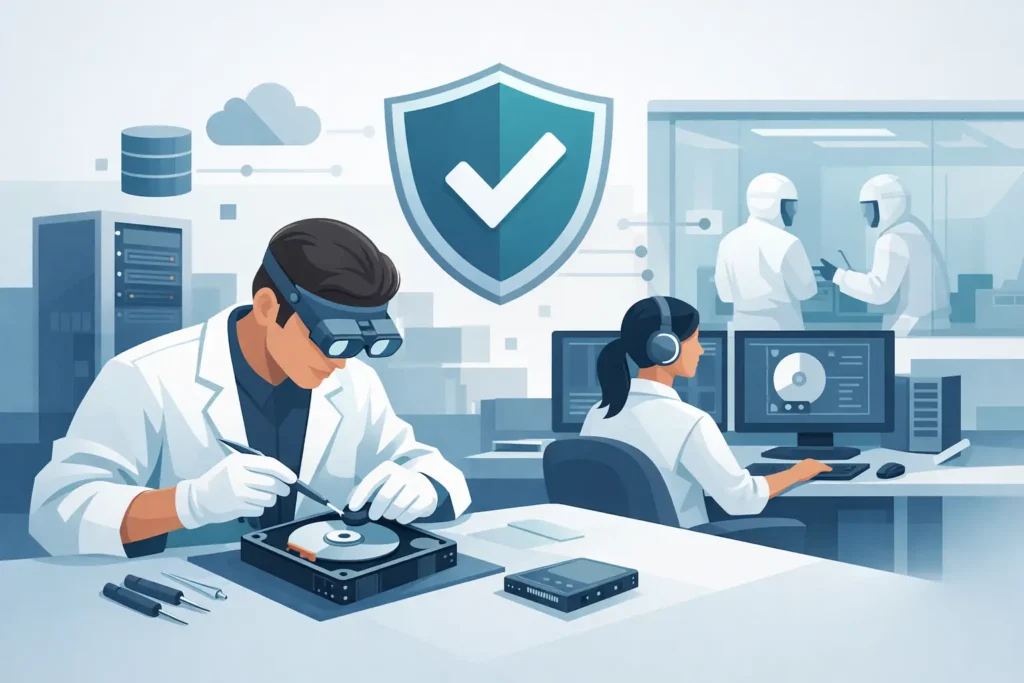
When a drive fails after years of business records, client files, family photos or legal evidence have built up on it, the wrong first decision can make recovery harder, slower, or impossible. That is exactly why choosing a certified data recovery lab matters. In a field where anyone can claim expertise online, certification, lab standards and real technical capability are often the difference between a controlled recovery and permanent loss.
Data loss is rarely just an inconvenience. For a business, it can mean downtime, missed deadlines, contractual exposure and reputational damage. For an individual, it can mean losing irreplaceable photos, messages, project work or personal records. In both cases, people are usually making decisions under pressure. That is when vague promises, virtual offices and low headline prices become especially risky.
What a certified data recovery lab actually means
A certified data recovery lab is not simply a repair shop that also offers file recovery. It should be a specialised environment with trained technicians, controlled procedures, secure handling and the equipment required to work on damaged storage media at a professional standard.
That includes the ability to assess and recover data from failed hard drives, SSDs, RAID arrays, NAS devices, USB sticks, memory cards, smartphones, laptops, Macs and surveillance storage. More importantly, it means understanding that each case needs the right method. Logical deletion, file system corruption, firmware failure, liquid damage and mechanical faults are completely different problems. Treating them the same is how recoverable data gets lost for good.
Certification also signals something broader than technical skill. It points to documented processes, accountability and standards that can be checked rather than merely claimed. In practice, that gives customers a stronger basis for trust.
Why certification matters when the stakes are high
The phrase itself can be used loosely in the market, so it is worth looking at what certification should translate to in real terms. A credible lab should be able to show that its technicians follow established procedures, that sensitive data is handled confidentially, and that the facility is equipped for professional recovery work rather than improvised repair attempts.
This matters most in high-stakes scenarios. If a solicitor needs deleted files recovered for a case, if a finance team has lost access to accounting records, or if a videographer has a corrupted memory card from a paid shoot, the issue is not just whether some files can be retrieved. It is whether the work is done securely, accurately and without unnecessary risk.
A proper lab environment reduces contamination risk when drives need internal work. Forensic-grade procedures help protect evidence integrity where chain of handling matters. GDPR-conscious handling helps protect personal and commercial data. These are not marketing extras. They are part of professional recovery.
Certified data recovery lab vs general repair shop
This is where many customers get caught out. A general electronics repair shop may be very good at replacing screens, batteries or charging ports. That does not mean it is equipped to recover data from a physically damaged hard drive or a degraded SSD controller.
Opening a failed drive outside controlled conditions can introduce particles that damage platters further. Running unsuitable software on a failing device can stress weak components and reduce the chance of a full recovery. Rebuilding a RAID without understanding the original configuration can scramble data structures that were still recoverable.
A certified data recovery lab should know when not to power a device repeatedly, when to clone first, when to work at component or firmware level, and when a case needs specialist handling because of encryption, file system damage or media wear. It is this judgement, as much as the hardware, that customers are paying for.
What to look for in a certified data recovery lab
The strongest providers make verification easy. They do not hide behind a call centre or a mailbox address. They can explain where the work is carried out, who performs it, and how your device and data are protected throughout the process.
A real lab matters. So do certified technicians, cleanroom capability where required, secure intake procedures and transparent quoting. If pricing is vague until late in the process, or if every case somehow becomes an urgent premium job, that should raise questions.
Customers should also look for operational details that indicate maturity rather than marketing gloss. Free assessment is useful because it removes pressure at the decision stage. A no-recovery, no-fee policy shows commercial confidence. Emergency options are important for business continuity, but they should be tied to actual lab capacity, not just a higher invoice.
It also helps to ask how the recovered data will be returned, how confidentiality is managed, and whether the provider can support both simple and highly complex recoveries. A lab that only handles basic deleted-file cases is not the same as one that can manage failed RAID, CCTV footage recovery or damaged SSD firmware work.
Why security and confidentiality cannot be treated as optional
When people think about recovery, they often focus on whether files can be restored. They should also think about who will have access to those files while the work is carried out.
A certified data recovery lab should operate with strict controls around customer data. That means secure storage of devices, restricted access, documented handling processes and clear confidentiality standards. For business clients, these points are often non-negotiable. For private individuals, they should be non-negotiable too.
The need is obvious in sectors such as legal, medical, financial and media production, but it applies just as much to personal devices. Phones and laptops can hold identification documents, private conversations, family media and account information. A provider that cannot explain how it protects that data is asking for trust it has not earned.
Speed matters, but method matters more
Many customers contact a lab because they need an urgent answer. That urgency is valid. Downtime costs money, and waiting for access to critical files can be deeply stressful.
But fast does not always mean reckless, and slow does not always mean thorough. The right lab should be able to triage quickly, give a realistic assessment and prioritise emergency cases without guessing. A skilled team can often identify the likely fault path early, but complex recoveries still require methodical work.
That is especially true with SSDs, RAID arrays and physically damaged hard drives. Rushing the wrong step can worsen the fault. Good labs move fast where they can and carefully where they must. That balance is one of the clearest signs of professional competence.
The pricing question most people ask too late
Cost matters, especially when data loss arrives without warning. But the cheapest quote is not always the lowest-risk option, and the most expensive one is not automatically the best.
What matters is whether pricing is clear, fixed once assessed, and tied to the actual complexity of the case. Customers should understand what they are being charged for, what happens if recovery is unsuccessful, and whether diagnostics are free. If a lab avoids direct answers or uses pressure tactics, walk away.
A trustworthy provider will usually explain that pricing depends on the device type, failure type, urgency and required lab work. That is reasonable. What is not reasonable is hiding the process until the device has already been handed over.
Choosing a lab with real-world capability
The market includes brokers, virtual brands and companies that outsource the technical work after collecting your device. That model can create delays, weak accountability and poor communication. If something goes wrong, it is not always clear who handled the device and where.
A specialised London-based provider such as Data Recovery Lab stands apart by combining forensic-grade capability, a real visitable lab, certified technicians, secure handling and a no-recovery, no-fee model. For customers, that means less uncertainty at the worst possible moment.
It is also worth choosing a team that works across a wide range of devices and failure types. Data loss does not always arrive in a neat category. A business might have a failed NAS with degraded RAID members. A parent might have a water-damaged phone. A creator might need corrupt video repair from removable media. A capable lab can handle all three without pushing the case elsewhere.
When the right lab gives you the best chance
No serious provider should promise a recovery before assessment. Some media is too badly damaged, some overwriting is too extensive, and some faults involve real technical limits. Honest labs say so.
What the right lab can offer is the best possible chance, based on controlled conditions, specialist tools, experienced judgement and secure process from start to finish. That is what certification should mean in practice.
If your data matters, treat the choice of provider as part of the recovery itself. A certified data recovery lab is not just a nicer label. It is often the clearest sign that your device, your information and your chances of recovery are being taken seriously from the first call.
