
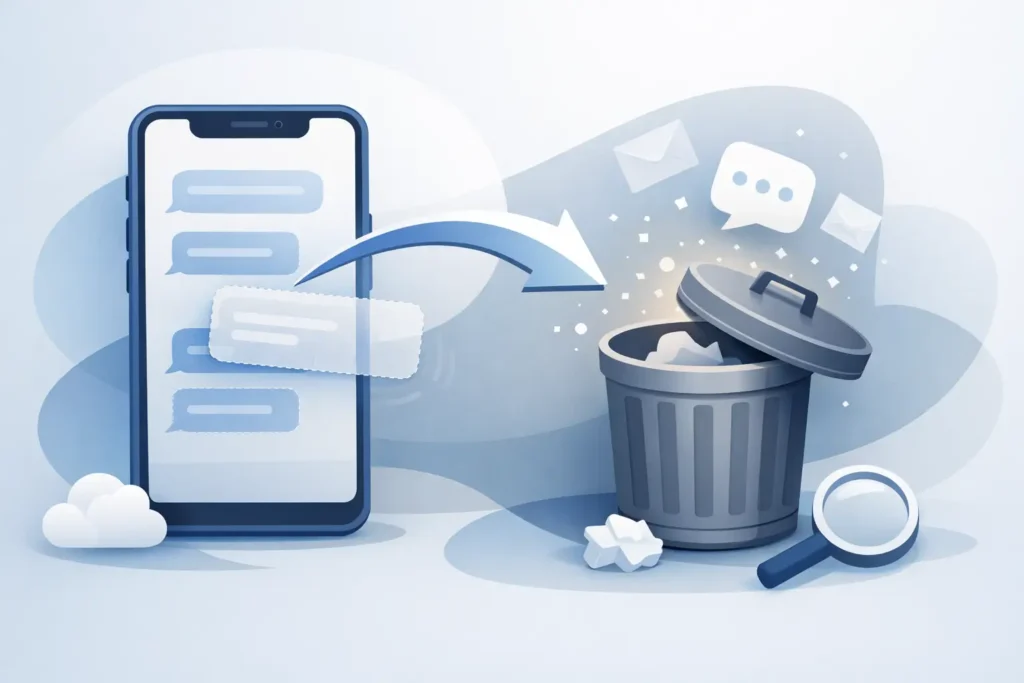
That sinking feeling usually starts with one thread. A client conversation disappears. A solicitor’s message chain is gone. A family text with a crucial address, photo or last voicemail transcript has vanished. If you need to recover deleted texts from iPhone, the right approach depends on one thing above all else – what happened after the deletion.
This matters because iPhone message recovery is not a single tool or button. Sometimes the messages are still sitting in Apple’s Recently Deleted folder. Sometimes they exist only inside an iCloud or computer backup. And sometimes they are no longer accessible through normal user methods at all. The biggest mistake is to keep using the phone heavily while guessing your way through recovery options. New activity can reduce what is still recoverable.
Can you recover deleted texts from iPhone?
In many cases, yes. But the route changes based on timing, settings and whether the phone has been backed up.
Apple now gives users a Recently Deleted section in Messages, which is often the fastest and cleanest option. If that is not available, the next question is whether Messages in iCloud was enabled, or whether the iPhone was backed up to iCloud or a computer before the deletion happened. Those methods can work, but there are trade-offs. Restoring a backup may replace newer data on the device. For business users or anyone handling sensitive communications, that is not a small decision.
If the messages are commercially important, legally relevant or emotionally irreplaceable, caution is sensible. DIY attempts are fine when the stakes are low. When they are not, every extra reset, sync or overwrite attempt can make the situation worse.
First check: Recently Deleted in Messages
If the deletion was recent, start inside the Messages app. Apple stores deleted conversations for a limited period before they are permanently removed.
Open Messages, tap Edit or the filters menu depending on your iOS version, then look for Recently Deleted. If the missing conversation appears there, you can select it and restore it. This is the least disruptive method because it does not require a full device reset or backup restore.
There are limits. If the folder has already been emptied, or the retention period has passed, those texts will not appear. The feature also depends on the iPhone running a version of iOS that supports it. If you cannot see Recently Deleted, that does not automatically mean the texts are unrecoverable. It just means you need to move to the next layer.
Recover deleted texts from iPhone with iCloud
There are two very different iCloud scenarios, and people often confuse them.
The first is Messages in iCloud. If this was turned on, your messages are synchronised across Apple devices. That can help, but it can also work against you. If a message is deleted on one synced device, the deletion may replicate elsewhere. In simple terms, syncing is not the same as archiving.
The second is an iCloud device backup. If your iPhone backed up before the messages were deleted, those texts may exist inside that earlier backup. To use it, you would normally need to erase the iPhone and restore from the chosen backup during setup.
That is where risk enters the picture. A full restore rolls the device back to the state captured in that backup. Anything added after that point may be overwritten unless separately saved. For a personal phone, that might mean recent photos, notes or WhatsApp content. For a work handset, it may mean newer business communications, app data or authentication changes.
Before restoring from iCloud, verify the backup date carefully. If the missing texts vanished yesterday but the only useful backup is three weeks old, you need to decide whether those messages are worth the data gap that restore could create.
Using a Mac or PC backup
If the iPhone was backed up to a Mac or Windows PC, recovery may be possible from that local backup instead. On newer Macs, backups are managed through Finder. On older macOS versions and Windows systems, they are often handled through iTunes.
A local backup can be valuable because some users back up to a computer more regularly than they realise, particularly if they have synced devices during updates or troubleshooting. Again, timing is everything. If the backup was made before the deletion, the messages may be included. If it was made after, they probably will not be.
The same warning applies here as with iCloud backup restoration. Restoring an iPhone from a local backup does not selectively place back one conversation. It generally restores the wider state of the device at that time. For anyone with critical newer data on the phone, that deserves proper thought first.
What if the texts are not in Recently Deleted or a backup?
This is where expectations need to be realistic. Apple’s security model is designed to protect user data, which is good for privacy but less convenient when data has been deleted. Once messages are removed from user-accessible areas and no usable backup exists, there is no guaranteed consumer-level method to bring them back.
That is also why many third-party apps overpromise. Some claim they can scan an iPhone and recover deleted texts instantly. In practice, results are often limited, inconsistent or dependent on old backups rather than direct recovery from the live handset. Some tools also require broad access to your computer and data, which raises obvious confidentiality concerns.
If the missing texts relate to a dispute, regulated information, internal business matters or private family issues, think carefully before uploading phone data into unknown software. Convenience should never come ahead of security.
When professional help makes sense
If the messages are genuinely important, expert assessment is the safer route. This is particularly true if the iPhone has storage issues, iOS corruption, accidental reset problems, backup failure, liquid damage or any sign of hardware fault. In those cases, the challenge is not just deleted texts. It may be broader data accessibility.
A professional recovery lab can assess whether the issue is logical, software-based or hardware-related, and whether there is a viable route to extract data without making matters worse. That distinction is critical. Repeated DIY attempts on a physically unstable device can reduce recovery chances.
For business clients, there is another factor: chain of custody and confidentiality. If deleted texts relate to HR matters, legal disputes, client communications or sensitive commercial information, the recovery process should be handled in a way that is secure, documented and GDPR-conscious. That is one reason many people move quickly from home troubleshooting to specialist support.
At Data Recovery Lab, cases involving smartphones are handled in a real London lab environment with controlled procedures, certified technicians and a no-recovery, no-fee approach. That matters when the phone in your hand is not just a handset but a record of business decisions, personal history or evidence.
What you should do immediately after deleting messages
If you are still early in the process, restraint helps more than experimentation. Try not to keep filling the phone with new photos, videos and app downloads. Avoid unnecessary resets. Do not repeatedly connect it to different systems or recovery tools just to see what happens.
Instead, check the obvious recovery paths in order. Look in Recently Deleted. Check whether another Apple device still shows the conversation. Review available backup dates. If the data is high value, pause before taking any step that erases or rewrites the handset.
This is one of those situations where speed matters, but panic does not help. The best result usually comes from the least invasive method that still fits the facts.
Common misunderstandings about iPhone text recovery
One common assumption is that deleted means permanently gone the second you tap bin. That is not always true, particularly with Recently Deleted and backups. Another is that if messages disappeared from the iPhone, they must still be safely stored in iCloud. That is only sometimes true, especially when syncing is involved.
People also assume they can recover one thread without affecting anything else on the device. Apple’s recovery options do not always work that neatly. In many real-world cases, restoring older messages means accepting some disruption or data management work elsewhere.
And finally, there is the belief that all recovery software is equally safe. It is not. Technical capability, data handling standards and transparency vary sharply.
If your deleted texts are replaceable, start with Apple’s built-in options and proceed carefully. If they are critical, treat the phone and its data like the high-value asset it is. A rushed attempt can cost more than the original deletion ever did.
The right next step is the one that protects both your messages and everything else you still cannot afford to lose.
