
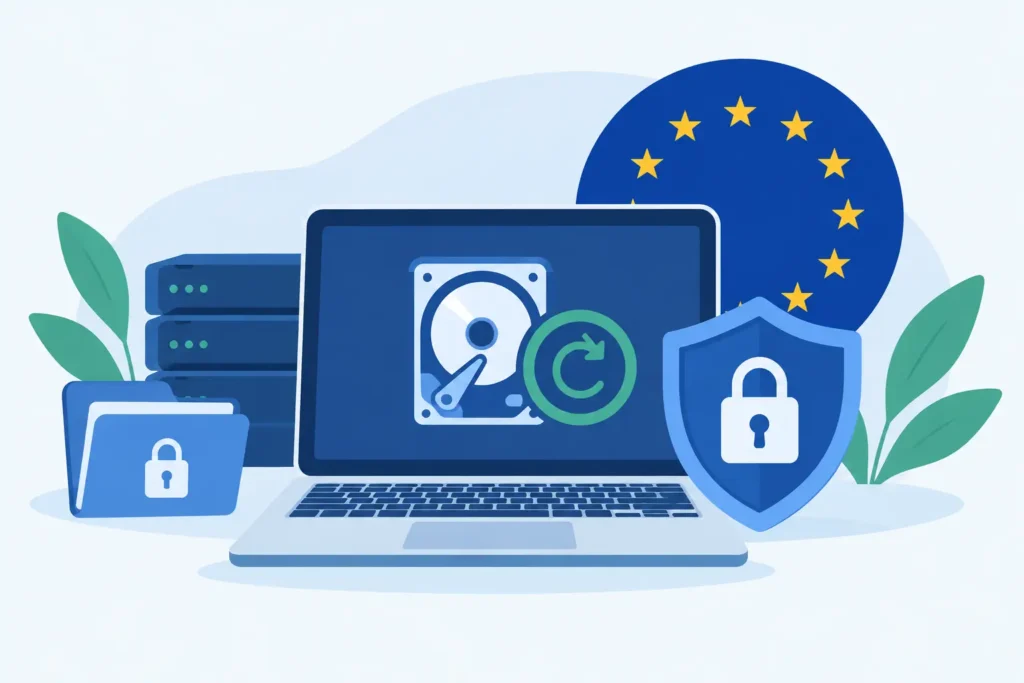
A failed drive can contain far more than files. It may hold payroll records, client contracts, patient correspondence, legal evidence, personal photographs, account credentials or CCTV footage. When that device leaves your possession for recovery, the question is not simply whether the data can be restored. It is whether GDPR compliant data recovery will protect it at every stage.
For UK businesses, a recovery service becomes part of the information-security chain the moment it receives a device containing personal data. For individuals, the stakes are just as real: private messages, identity documents and family memories should not be exposed because a laptop, mobile phone or external drive has failed. Competent recovery work must therefore combine specialist technical methods with controlled handling, clear accountability and secure return or destruction of data.
What GDPR compliant data recovery means in practice
The UK GDPR does not prohibit sending a failed device to a specialist laboratory. It requires the organisation responsible for the data to use an appropriate supplier and put suitable safeguards in place. In many business recovery cases, the customer remains the data controller and the recovery company acts as a processor, handling data only to perform the agreed recovery work. The exact roles can depend on the circumstances, but the obligation to define them clearly does not.
A credible provider should be able to explain how it protects confidentiality from collection to return. That includes secure transport, recorded receipt of the device, restricted laboratory access, controlled access to recovered files, encrypted storage where data must be copied, and a documented deletion process when the job is complete.
Technical success alone is not enough. A laboratory may recover every file from a damaged RAID array, but if an unauthorised person can view, copy or retain those files, the process has failed the customer. Privacy controls must be built into the workflow, not added as a promise at the end.
The recovery process must protect data at every handover
The riskiest moments are often the practical ones: the drive is collected, transferred between technicians, imaged for analysis, or returned to the customer. A professional laboratory should maintain a clear chain of custody that shows where the device has been, who has handled it and when. This is particularly valuable for legal, financial, healthcare and corporate data, where an unexplained gap can create serious compliance and evidential concerns.
Secure collection matters. A failed device should not be sent around an office, left at a reception desk or passed between unverified couriers without records. It should be packaged to prevent further physical damage and tracked from collection through to assessment. Once received, the device needs a unique job reference and secure storage away from public or unauthorised access.
Inside the lab, access should be limited to trained technicians with a genuine need to work on the case. The customer should not have to accept a vague assurance that “the team” will look after it. Ask who can access the device, whether access is logged, and whether subcontractors or overseas facilities are involved. If a provider cannot answer directly, that is a warning sign.
Recovery copies need the same protection as the original
Data recovery often requires a technician to create a forensic image or working copy. This is normal and frequently essential, especially where an unstable hard drive, SSD, NAS or RAID system could deteriorate during repeated reads. However, every copy increases the data-protection responsibility.
Recovered data should be held only for as long as necessary, stored in protected systems and transferred through an agreed secure method. For highly sensitive cases, the customer may need to nominate approved contacts, provide encrypted storage for the return, or collect the data in person. There is no single method suitable for every case. What matters is that the return route matches the sensitivity of the information and is agreed before files are released.
GDPR is not just a confidentiality statement
A privacy policy on a website does not, by itself, make a recovery provider suitable for sensitive data. For a business engagement, the contractual and operational details matter. The agreement should set out the scope of processing, the type of data involved, the purpose of recovery, confidentiality duties, security measures, retention periods and what happens if an incident occurs.
Under Article 28 of the UK GDPR, controllers using processors have specific obligations. A recovery supplier should be prepared to support those obligations rather than treating them as unnecessary paperwork. This is especially relevant when the failed storage contains employee records, customer data, special category data, payment information or information subject to legal privilege.
Security also needs to be proportionate to the risk, as required by Article 32. A memory card containing holiday photos and a server containing thousands of customer records are not equivalent cases. Both deserve confidential handling, but a large-scale corporate recovery may require stricter authorisation, enhanced reporting, controlled return media and a defined escalation route for the customer’s IT or compliance team.
Questions to ask before you hand over a device
When data loss is urgent, it is tempting to choose the first company that promises a quick fix. A few direct questions can prevent a difficult situation becoming a reportable data incident. Ask whether the provider has a physical, visitable laboratory; how devices are collected and logged; who can access the data; where recovered copies are stored; and when all retained copies are securely deleted.
You should also ask whether the recovery is carried out in-house. Some businesses advertise recovery services but forward devices to third parties, potentially without making the handling chain clear. There can be legitimate reasons to involve specialists, but you need to know who will process the data and under what safeguards.
For organisations, request documentation before approving the work. This may include a data processing agreement, confidentiality terms, security information, insurance details and confirmation of the proposed retention period. If your internal policies require it, involve your data protection officer, IT lead or legal team early. Waiting until data has already been transferred is too late to make an informed supplier decision.
What to do immediately after a data-loss incident
Protecting personal data starts before the recovery lab receives the device. Stop using the affected drive, mobile phone or server where possible. Continued use can overwrite deleted information, worsen physical damage or alter evidence that may later matter to an investigation. Do not install recovery software on the failed device, and do not repeatedly power-cycle a clicking hard drive or a failing SSD.
If the device contains business or sensitive personal data, record the basic facts: when the fault occurred, who has had access to the device, whether it was encrypted and whether the loss involved theft, unauthorised access or simply a technical failure. A hardware failure is not automatically a personal data breach. But if confidentiality, integrity or availability of personal data may have been compromised, your organisation should assess the incident under its breach-management procedure.
Then choose a specialist that can assess the device without pressuring you into unnecessary work. A transparent diagnostic process, a fixed quote before recovery and a no-recovery, no-fee approach reduce both commercial risk and the temptation to make rushed decisions. Data Recovery Lab applies these controls alongside forensic-grade recovery methods, secure handling and a real London laboratory customers can visit.
Why specialist capability supports compliance
GDPR compliance and technical competence are closely connected. Poor recovery attempts can destroy data that might otherwise be recoverable, while inexperienced handling can expose files unnecessarily. Cleanroom work for physically damaged hard drives, controlled firmware procedures, forensic imaging and secure RAID reconstruction are not marketing extras. They help technicians recover data with fewer risky interventions and a clearer record of what has happened.
The right approach also recognises limits. Not every device can be recovered, and not every file can be reconstructed intact. Encryption keys may be unavailable, overwritten sectors may be gone, and severe physical damage may rule out a successful result. An honest provider will explain these limits while protecting the information that remains accessible.
When a device holds data you cannot afford to lose, treat recovery as both a technical and a privacy-critical task. Preserve the device, document the incident and choose a lab that can show exactly how it will protect your data before, during and after recovery.
